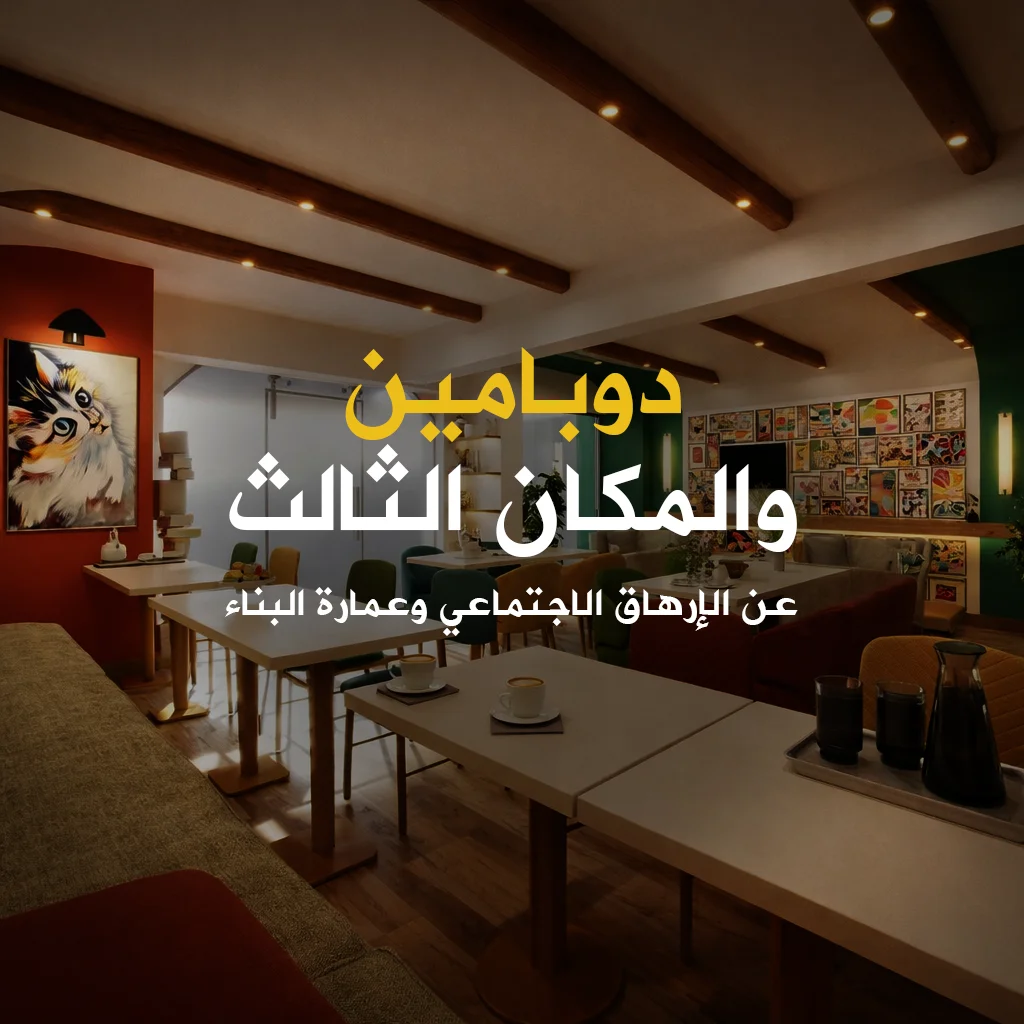
On the "Third Place," Social Burnout, and the Architecture of Belonging
"Contemporary urban life has become sharply divided. The home is a private space. Work is a space of pressure and productivity. Commercial spaces, more often than not, are designed for fast movement rather than for lingering. Within this division, something essential is lost: a space that allows a person to live a more balanced side of their day. A space where they can work, meet, learn, experiment, or even just stay a while, without always being required to perform a specific role."
By: Cube Team•2026-04-21
There is a special kind of fatigue that defines contemporary urban life. Not merely physical exhaustion, but social exhaustion as well. A person leaves home already carrying the weight of work, arrives at work already lacking comfort, and ends their day without finding a single place that feels both public and human at the same time. Our cities today still provide movement, consumption, and duties. But they often fail to provide something simpler and deeper: a place where one can simply exist — to work without pressure, to meet others without performativity, to learn without institutional rigidity, and to spend some time without feeling out of place. On many days, what people lack is not just time, but also place.
"On the "Third Place," Social Burnout, and the Architecture of Belonging"
Architecture makes certain forms of living together possible.
This is where the concept of the "third place" becomes important.
Contemporary urban life has become sharply divided. The home is a private space. Work is a space of pressure and productivity. Commercial spaces, more often than not, are designed for fast movement rather than for lingering. Within this division, something essential is lost: a space that allows a person to live a more balanced side of their day. A space where they can work, meet, learn, experiment, or even just stay a while, without always being required to perform a specific role.
This is not a matter of luxury. It is a matter of the very quality of life. When the in-between spaces between home and work disappear, the city becomes harsher, individuals become more isolated, and daily life loses one of its most important elements: its human rhythm.
Architecture alone cannot solve the problem, but it can respond to it. And the third place is one of the most intelligent and quiet responses.
What is the Third Place?
The concept of the third place refers to the space between home (the first place) and work (the second place). It is not merely a café, a co-working space, or a public space in the traditional sense. The third place is a social environment that allows people to return to it regularly, to feel comfortable there, and to find a lighter, more human form of public life.
For a place to truly function as a "third place," several conditions must typically be met: It must be welcoming, not overwhelming. It must allow different modes of presence, not one predetermined behavior. People must be able to stay in it, not just pass through it. Its environment should support conversation, quiet work, spontaneous encounters, and repeated visits. Most importantly, it must reduce friction. The third place succeeds when people do not have to justify why they are there. They simply enter, settle, and become part of its rhythm.
This was the deeper question behind Dopamine Café.
Dopamine was not designed as a co-working space in the narrow sense. Rather, it was designed to be a place where people could acquire new creative skills within an environment warm enough to feel like home. This distinction is not superficial. Traditional co-working spaces often organize people around productivity alone. Dopamine, however, starts from a broader understanding of human life. People need to work, yes, but they also need to gather, to pause, to learn, to eat well, and to feel welcome without being asked to choose a single identity each time.
For this reason, the ground floor was imagined as a public space with a domestic character. It is a smoke-free environment where visitors can enjoy healthy food and drinks, while also finding space to work, study, or spend time with others without the pressure of constant activity. This point is more important than it may first appear. Spatially speaking, serving food is one thing; creating a space where people want to stay, not just pass through, is something else entirely.
On the upper floor, this idea continues but with a different tone. Instead of repeating the ground floor, it opens up space for friendly gatherings and creative, skill-based activities. This is a crucial element of the project's identity as a third place. A successful third place does not trap people within a single social script. Rather, it offers multiple ways of belonging. Someone might come for a late breakfast, later return to work with focus, and then discover a creative practice or group activity that transforms what the place means to them. This layering is not accidental. It is architectural.
it's not only a graphic identity
For such an idea to be convincing, the interior design could not rely on visual identity alone. It had to produce comfort at the level of materiality itself. This is why wood and natural light were essential elements of the approach. Both are familiar in design, but that familiarity is precisely the point. They soften the boundary between public and private experience. They reduce the institutional character that makes many multifunctional spaces emotionally flat. Comfortable furniture, especially sofas, was also used to support a more relaxed posture of dwelling and use. A person sitting on a sofa does not behave as if sitting on a high café stool or an office chair. The body changes first, and the social atmosphere follows.
At the same time, the place had to have a clear identity. The challenge was not just to make it comfortable, but to connect its multiple functions without fragmentation. Work, food, gathering, and creativity could easily become separate zones with separate moods. At Dopamine, these functions were connected through a consistent internal language: lively enough to feel vibrant, coherent enough to feel unified. The goal was not visual novelty but social continuity.
Here, architecture transcends the boundaries of aesthetics and becomes a form of social organization.
When we speak of the "third place," we are really speaking of a framework of relationships
When we speak of the "third place," we are really speaking of a framework of relationships. Who feels welcome here? How long can they stay? Can they come alone without feeling isolated? Can they meet others without feeling exposed? Can the space accommodate both concentration and relaxation, both individuality and participation? These are social questions, but they are answered spatially: through light, furniture, movement, materials, layout, and overall mood.
Dopamine responds to these questions with balance, not spectacle. It does not announce itself as a theory. It behaves like one. It offers familiarity without becoming private. It supports work without becoming institutional. It encourages gathering without becoming chaotic. It invites creativity without isolating it within an elite or limited program.
In this sense, it achieves the core criteria of the third place: accessibility, comfort, repeatability, social openness, and the ability to contain different forms of daily life within one coherent environment.
The importance of this coherence lies in the fact that the deeper social problem was never merely the absence of cafés or workplaces. Rather, it was the absence of places where people could experience themselves as more than workers, consumers, or isolated individuals. The third place restores this lost middle ground. It gives public life a more human scale.
This, for us, is what Dopamine represents.
Not merely a café. Not merely a co-working space. But an environment carefully shaped to support a modest yet important form of social restoration: rebuilding comfort, creativity, and belonging in everyday life.
And perhaps here, precisely here, architecture still retains one of its most meaningful responsibilities. Not only to house activities, but to make certain forms of living together possible.