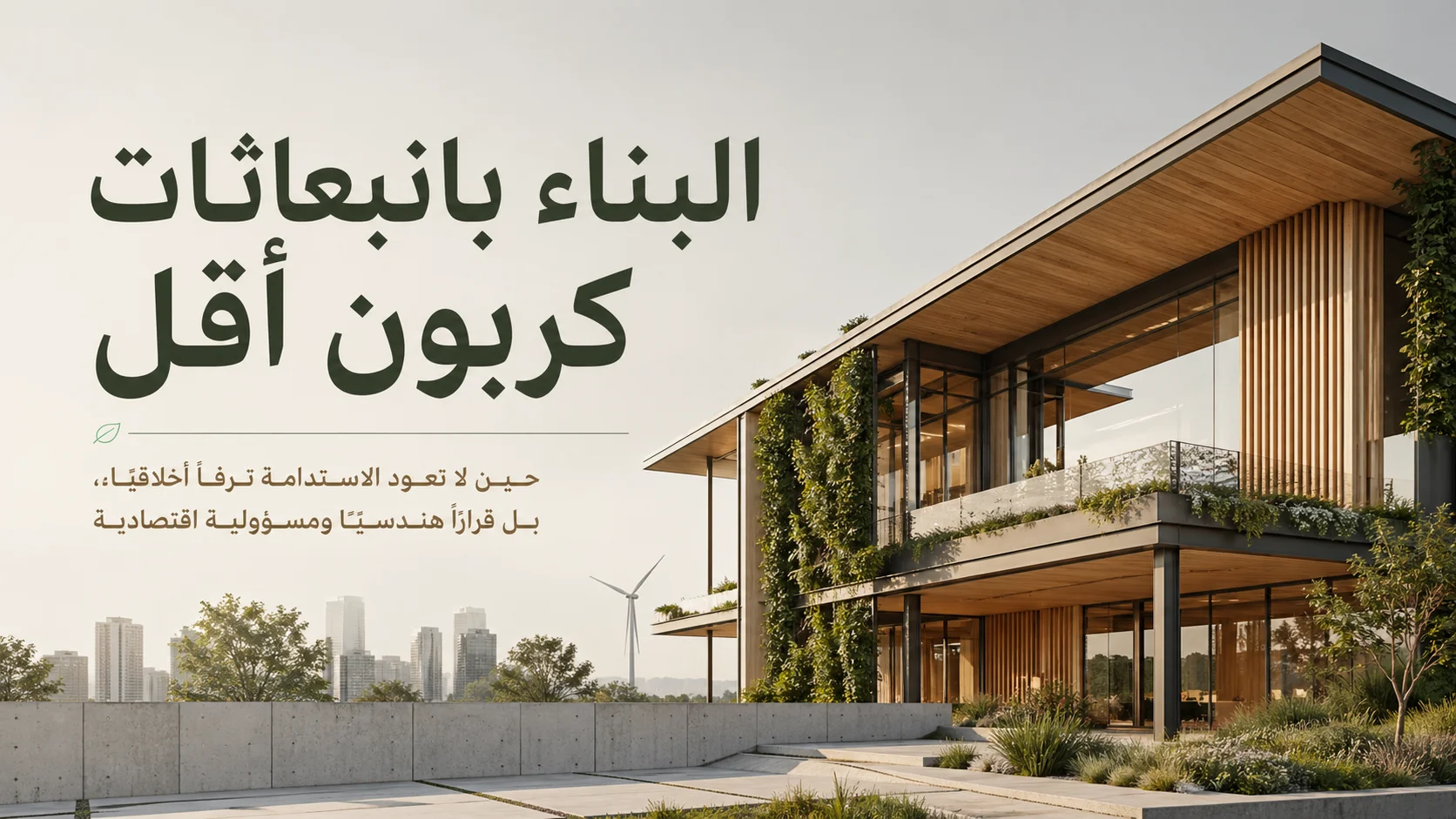
When sustainability is no longer a moral luxury, but an engineering decision and an economic responsibility.
“On a construction site, things always seem heavy. Concrete, steel, the movement of trucks, and the pressure of time pushing on everyone from the outside. And in the middle of this scene, it’s easy to think of building as a purely physical act: we lift, we pour, we seal, we hand over. But what doesn’t always show to the eye is that every one of these decisions leaves another kind of impact—quieter, longer‑lasting: its carbon footprint.
By: Cube Team•2025-02-06
Building with lower carbon emissions.
"“Buildings were responsible for 37% of energy‑ and operations‑related carbon dioxide emissions."
“According to the United Nations Environment Programme
ut talking about lower carbon emissions doesn’t just mean building ‘green’ in the promotional or superficial sense
Nor does it mean adding a few technologies at the end of the project so we can declare the building more sustainable. The issue is far deeper than that. It begins with the very question that good architecture must always ask:
“How do we build in a way that achieves the required performance, without unnecessary waste in material, energy, complexity, or time?
In this sense, carbon is no longer just an environmental issue, but a design issue as well. Buildings with lower emissions are not the product of moral sensitivity alone, but of engineering clarity: of reducing improvised decisions; of calibrating the relationship between form, structure, and systems from the very beginning; of choosing materials and construction methods that do not raise the project’s environmental cost unnecessarily. And of one simple yet decisive understanding: every uncalculated complexity, every rework, every late conflict between design and execution is also additional emissions—long before it becomes additional cost.
This is why building with lower carbon emissions is not merely a matter of choosing ‘better’ materials, but of choosing a better methodology.
In many projects, the problem emerges in the space between vision and execution. The architect sets a concept, and then the constraints arrive later. Engineering systems enter too late, forcing adjustments. Materials change, work is repeated, energy, time, and budget are wasted. This is the kind of friction that not only disrupts the project, but also increases its environmental impact. It is precisely that ‘gap that breaks projects,’ as articulated in Cube’s marketing vision: the gap between architectural vision, engineering constraints, and the reality of execution.
From here, reducing emissions becomes a natural result of something that, at first glance, seems unrelated to it
Design as a system, not a drawing
This aligns directly with the way Cube defines itself: a practice that integrates architecture and engineering within unified solutions, relying on advanced construction systems and a modern digital approach to achieve high‑efficiency, high‑quality outcomes. Its vision and mission do not separate technological precision from artistic elegance; rather, they place this intersection at the heart of improving quality of life and creating smarter, more sustainable environments.
And when sustainability is read from this perspective, it moves from decorative language to the language of decision. An investor does not buy ‘the green color.’ And a project manager does not need a general moral speech as much as he needs clarity: How will we reduce waste? How will we increase execution efficiency? How will we build faster and with less chaos? How will we achieve better performance without unnecessary inflation in material and energy?
This aligns with Cube’s strategic materials, which emphasize that the target audience does not buy architecture as an abstract form, but buys solutions to problems, money saved, productive comfort, and reduced risk
For this reason, reducing carbon in construction should not be presented as a sacrifice of performance or beauty.
On the contrary. When a project is well‑calculated, sustainability becomes a form of precision. Material efficiency becomes part of efficiency in avoiding error. Thoughtful speed becomes part of reducing waste. And advanced systems—such as off‑site construction, or lighter, more controlled building systems—shift from being mere execution tools to tools for reducing environmental impact as well, because they reduce improvisation, increase discipline, and link the design decision to its executional reality from the very beginning. This aligns with Cube’s repeated emphasis on industrialized systems, the integration of architecture and engineering, and reducing friction between concept and execution.
But more importantly, this kind of building changes the way we think about the entire project. Instead of asking at the end: ‘How sustainable has the building become?’ Perhaps we should ask at the beginning
Was the project designed, from the start, to require the least possible amount of waste?
Only then does sustainability become truly architectural. Not an afterthought, not a cosmetic layer, not a public‑relations language— but an internal logic that governs the project from the first decision to the last detail.
And this, at its core, is the meaning of building with lower carbon emissions: to build with greater intelligence, not merely with different materials; to narrow the gap between concept and execution; to make technology serve the actual performance of the place, not just its image; and to understand that environmental responsibility does not begin after the building is complete, but with the way we chose to build it in the first place.
And perhaps for this very reason, the real question today is not: ‘Can we build with lower emissions?’ but rather: ‘Can we still consider any building good if it has not thought about its impact from the very beginning?